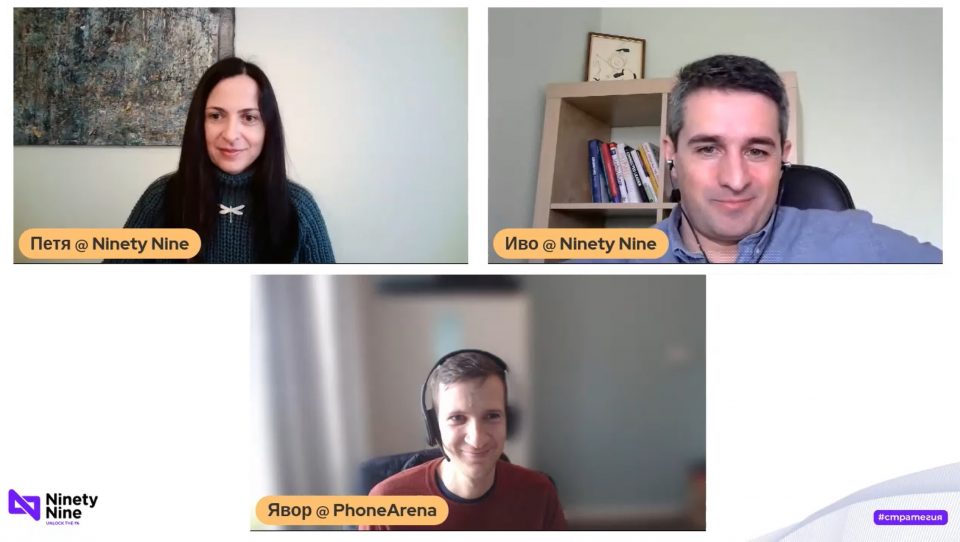
An interview by Petya Lozanova with Yavor Popov, CEO of PhoneArena
In partnership with Ninety Nine, PhoneArena—one of the world’s best-known technology media platforms—completed a strategic-planning process in 2021 to choose the company’s long-term direction. In this interview with Yavor and Ivo, we discuss how such a process works, how it impacts the company and its leadership team, and what any organization considering strategic planning should keep in mind.
#1 Before we hear from Yavor, I would like Ivo to briefly describe the project we completed.
The purpose of the project was to help PhoneArena team choose a strategic direction for the organization over the coming years. We provided the methodology and facilitated a series of meetings in which the team had to make decisions on several important questions. The first was to identify the organization’s strategic options. For each option, the team then considered which markets the company would serve, which strategic objectives it would pursue, and which strategy would be the most reasonable and effective. The final task was to choose one strategic development option and continue working on it. We used the Management Systems methodology, which provided a structure for analyzing markets, the external environment, trends, competition, and the company itself. This enabled the team to address another essential question in any strategic initiative: “What capabilities must the organization develop in order to execute its chosen strategies and compete successfully in its target markets?” That, in brief, was the project. It is also important to note that it was supported by the European Bank for Reconstruction and Development through its program for innovative small and medium-sized companies in Bulgaria.
#2 Yavor, why did PhoneArena decide to launch this project, and what was your objective?
Our reasoning was straightforward: we needed this type of project because the company’s short-term focus was extremely clear. By short term, I mean the next 12 to 18 months. Beyond that, however, we faced a wide range of development opportunities in a relatively dynamic media market. We operate primarily in the United States, where the market changes quickly, so the question was which of those opportunities we wanted to pursue. Someone in my position has several options. I could take a more authoritarian approach and say, “As CEO, I believe this is the right direction, so this is where we are going. Everyone, come along.” My idea was different. I believe a successful strategy rarely comes from one person alone, especially when a company has several viable growth options. We were not in a situation where we were about to run out of money or were effectively at war and needed immediate, unequivocal decisions. We were a growing business with a clear view of the next 12 to 18 months. It therefore made sense to involve as many members of the leadership team as possible and build a coherent strategy that considered the external environment, our internal situation, the competition, our business model, and how that model might evolve. That seemed like the right way to think.
From there, you have two choices: try to do it yourself or seek help from people who have already been through the process. We turned to Ninety Nine largely because they could provide the methodology Ivo described. It does not provide the answers, but it offers a framework for thinking. The company using that framework must still do the work and make the decisions. Those were the main reasons we chose this path.
#3 You said that you involved the leadership team in the project. What effect did working on it together have on the team?
Before discussing the effect, it may help to give some context about PhoneArena and its leadership team. We currently have close to 50 people, so we are by no means a huge organization. At the same time, we are large enough to have several functions with distinct responsibilities, each led by people who are specialists in their field. One objective of the exercise was for the different team leaders to develop a broadly shared understanding of every part of the business, so that they could make decisions about their own functions through the lens of the organization as a whole. When we began the work last year, that was not yet fully how we operated. We had specialists focused on their own areas, and we had always held leadership meetings, but these connections do not develop properly unless you dedicate focused time to them.
That was one of my goals in involving the leadership team: I wanted everyone to understand the external environment, our internal environment, and our competitors in greater depth. Each person previously had only a partial perspective. As a media company, our editorial team understood competitors from the perspective of written content; the monetization team understood the commercial landscape; and the product and engineering teams saw an entirely different part of the picture. Everyone had fragments of insight into the other functions. One result of the project was that the leadership team learned far more about the organization and its position in the market. They now understand our competitors better, know which development opportunities are available to us, and understand why we chose these opportunities rather than others. This is extremely important when making everyday decisions through the lens of both short- and long-term strategy. It created a level of alignment across the leadership team that would not otherwise have emerged.
That was certainly one effect, but there were many other positive consequences of working together. The leadership team collaborated on a longer-term project, which built greater trust and helped people get to know one another better—especially in a remote environment. There were many benefits.
We should also be honest: the process has a price. Strategic planning consumes time. The investment is entirely justified, but anyone undertaking it needs to understand that the work will not produce anything valuable unless people give it the attention it requires. Yes, it took time, and yes, it came on top of everyone’s daily responsibilities. But we all came away with a much better understanding and a far clearer view of what we wanted to do.
One phrase I particularly like comes from a UK-based coach who has worked with many founders: “clarity over certainty.” A strategy will never provide complete certainty. We can never be 100% sure that a particular choice will succeed. The clarity it provides—a path and a direction—is the most important effect on the leadership team. Everyone knows where we are going, everyone has participated in choosing that direction, and everyone has a meaningful understanding of what they need to do. That clarity is liberating. It gives people room to contribute within a clear frame without becoming lost among the thousands of things they could potentially pursue. For me, that was the greatest effect: clarity over certainty. This exercise gave us that clarity.
#4 Ivo, based on your experience with different companies, what value does an organization gain from going through this kind of process?
First, I fully support what Yavor said about alignment. The time key managers spend thinking through these questions pays off later through faster strategy execution and greater clarity in every subsequent decision about the organization’s development. Without that alignment, everyday work becomes filled with long, repetitive debates: Is this more important, or that? Should we take this step, or is the next priority more urgent? The time will be spent either way. The question is whether we spend it creating alignment or arguing. That is unquestionably one of the major benefits.
I would add another. In the world in which we now operate, every organization needs to pause periodically and review its strategy and strategic positioning. Doing this regularly and in a structured way helps the company develop adaptability and flexibility. These capabilities have become critical for almost every business. A strategic-planning process helps build them at several levels: in managers’ understanding, in the organization’s practices and tools, and as an organizational competency. While working through the steps, managers also strengthen their own capabilities in strategic management and strategic thinking. I hope Yavor will share his view on that as well.
(Yavor) I completely agree with Ivo that this capability develops through the process. Strategic planning is not merely an exercise; it is an organizational competency. When it has never been practiced, has been practiced only rarely, or has been approached poorly, the capability may be absent or underdeveloped. The process definitely strengthens it in everyone who participates.
#5 One final question for both of you, starting with Yavor. What would you recommend to a company that is only beginning to consider whether to start such a process—and how should it begin?
(Yavor) As organizational leaders, we usually feel certain “pains,” and those pains are often signals that something is not working properly. What does the absence of a coherent strategy feel like? There are several signs: you spend an enormous amount of time wondering which short-term decision is right;
you do not know how to measure success and keep asking whether something is going well or badly and whether you are moving in the right direction;
the leadership team constantly disagrees about what the priorities are;
roles and responsibilities remain unclear, with different people pulling in different directions and no clarity about who should decide;
there is no alignment among the colleagues doing the day-to-day work. They cannot explain what the company is trying to achieve this quarter or this year, or where it is going; they can only tell you what they are working on this week.
These are all signs that the strategy is either absent or exists only in the minds of a few people and has not been aligned across the organization. When you experience several of these pains, it is worth considering the role strategic planning might play, whether you need it, and how much it could help. These signals can also point to other problems, but when several are present, there is probably an issue with strategic planning, strategy communication, or strategic clarity.
We all tend to believe the strategy is perfectly clear. Yet when different members of the leadership team are asked to describe it, their answers may be completely different. If you notice that, you should certainly consider a strategic-planning process.
Your question has two parts: whether to do it and how. The approach will differ considerably depending on the organization’s situation. In one sense the process is always similar: you need structure and a framework through which to conduct the analysis. The framework Ninety Nine use is strong and provides a very good basis for the work.
To do the process properly, a minimum level of effort is unavoidable, although the exact investment depends on where the company is. You are flexible enough for the process to take three months, nine months, or anything in between. You can correct me, but in my view it will not happen in two meetings. Three months feels like a reasonable minimum. I would definitely avoid the approach of saying, “Let us gather the leadership team and do strategic planning for three days.” I do not think that works. The process needs a broader base and much more time, thought, and alignment on what matters, why it matters, and how to respond in different situations. There is an initial investment. After that, the strategy can be maintained through a quarterly one-day review of progress against strategic goals and an annual planning cycle. But without an initial framework, decisions are made largely by instinct. Some people may have excellent instincts, but without a framework the likelihood of failure is much greater.
#6 An organization must be willing to invest in order to achieve a high-quality result from strategic planning. Ivo, what is your perspective? What would you recommend to an organization considering the process?
First, choose a methodology and follow it. We could debate at length which methodology is best, but each has its advantages. The main value of a methodology is that it provides a framework and ensures that everyone is speaking the same language. I have seen many do-it-yourself exercises in which most of the time is spent not on strategy, but on arguments about definitions: What is a mission? What is a vision? What is strategy? Do values belong in the process? These debates are generally a waste of time because, whatever labels we use, the work comes down to a small number of fundamental strategic questions that must be answered. It does not matter whether we call something a mission, a business definition, or a vision. What matters is knowing the exact question and understanding which question we are answering. Choosing a methodology creates that clarity and a shared understanding of the result we are trying to achieve.
Second, I recommend using a neutral facilitator. Strategic meetings can become spaces in which different agendas are promoted, and for some organizations this is a very real risk. An independent external facilitator protects the process from agendas that may not be right for the organization. That is another major benefit.
I also fully agree with Yavor that the organization must be prepared to pay the price in time and devote as much time as the work requires. The thinking needs to mature, and the assumptions need to be tested. I am not suggesting that the process should continue indefinitely, but it should be done once and done properly—and that takes time.
(Yavor) All methodologies are broadly similar. Yes, there are differences, but ultimately they pursue the same goal. Even if you choose the “wrong” methodology, that may affect only 5% of the outcome. We are looking for the 80/20: the essential issues and the key questions that need answers. Whether the framework uses mission, vision, or business definition is not especially important. What matters is having a framework and ensuring that the person leading the exercise knows it extremely well. That is why I support Ivo’s recommendation to hire an external facilitator. It is a small price to pay.
Having an external person is valuable for two reasons. First, the facilitator prevents the discussion from drifting away from the purpose of the exercise. Second—and I would compliment you on this—the facilitator does more than ask questions. They listen from outside the organization, without the same assumptions or accumulated baggage. Several times during our process, we would discuss something for half an hour and then Ivo would ask one question that made us realize, “Yes, that is exactly what we have been saying. Now we understand one another.” An external person can do that much more easily than people inside the organization, who are already shaped by their own information and expertise. I would not attempt the process alone. Without a facilitator who knows the framework, can guide the discussion, and does this professionally every day, the time cost would be much higher. Facilitated strategic planning is, in my view, the right approach.