
“The way a team plays as a whole determines its success. You may have the greatest group of individual stars in the world, but if they do not play together, the club will not be worth a dime.”
Babe Ruth
As in sports teams, the relationships within a training group—and the extent to which people act together—shape both the success of the group and the experience of each individual within it. Bringing people together inevitably creates group dynamics: a process that can deepen learning or stand in its way.
What exactly do we mean by group dynamics?
Group dynamics are the psychological and behavioral processes that take place within a group. These processes affect both the effectiveness of each individual member and the effectiveness of the group as a whole.
The main elements of group dynamics we will consider here are:
- Processes related to building relationships within the group
- Processes related to achieving the learning objectives and making learning effective
- Individual behaviors
When we acquire knowledge or practice skills in a group, everything we do in the shared space affects learning: where and beside whom we sit; how we connect with others; how we present ourselves; which people we feel close to and where tension arises; and how closely our individual learning objectives align with the group’s shared goal. This is especially true in experiential learning, where the most important insights emerge through interaction and personal experience within the group.
What happens, however, in online training groups where the classic group format is absent?
In a virtual environment, we observe three effects that make group dynamics more difficult to develop and hinder group cohesion.
1. A sense of safety through distance
Each participant is alone in their own space, with no direct physical contact between the facilitator and participants or among the participants themselves. This can create a sense of safety and the attitude, “If something does not work for me, I can simply disconnect.” Participants may isolate themselves and miss opportunities for interaction, communication, and learning.
2. Greater difficulty creating a sense of shared time and space—the here and now
When people share the same physical space, they have far more opportunities for informal communication. They get to know one another better, relax more quickly, and become more willing to take risks and experiment. As a result, they learn faster and more deeply.
3. A habit of passive participation and active facilitation
In face-to-face training, participants are expected to engage actively. Online training, however, is still often associated with video lessons or webinars in which participants remain passive. Passivity removes the opportunity for experience and therefore makes learning more difficult.
Compensating for these effects requires the trainer’s role in the group process to change:
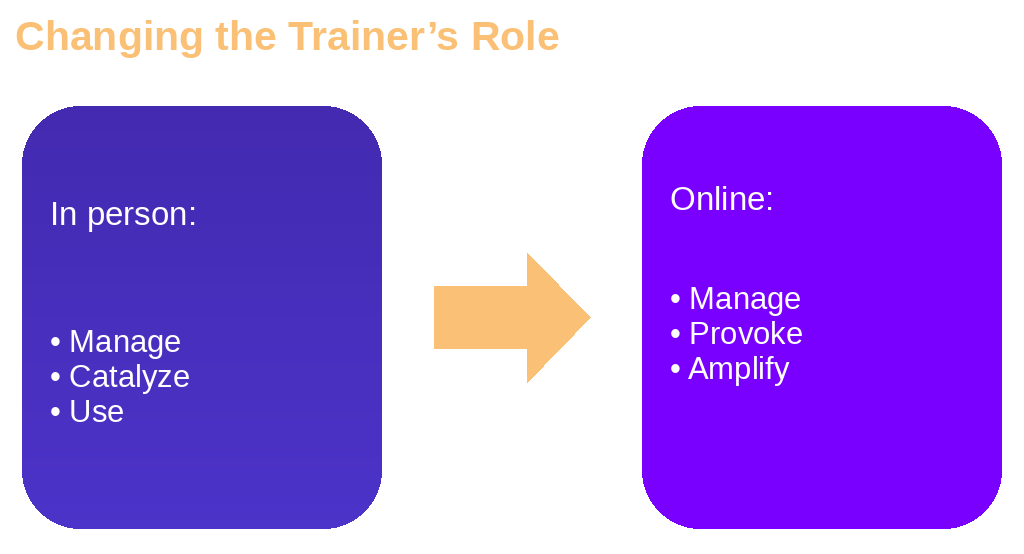
To stimulate and strengthen group dynamics, the trainer must plan interactions far more actively—both between the trainer and participants and among participants—across every element of the group process.
What can we do when we design an online program to develop each element of group dynamics?
Element 1: Processes related to building relationships within the group
These are the processes through which people develop closeness, build trust, and create group cohesion—the positive sense of connection, safety, and desire to spend more time with the group.
By creating a sense of belonging, these processes also have a strong influence on participants’ subjective satisfaction with the training.
Trust helps participants feel safe enough to ask questions and share insights or difficulties, increasing the learning effectiveness. Strong relationships also support cooperation and mutual support. This reinforces the sense of learning through shared experience and gives participants greater ownership of what they have learned, because the insight appears to have been created independently of the trainer—at least on the surface.
Design approaches that can strengthen this aspect of group dynamics include:
- Working in small groups. The format should reflect the broader objective: 1) stable groups that work together throughout the program to build closeness and collaboration, or 2) changing groups that allow participants to get to know as many people as possible
- Sharing rituals
- Gamification that encourages participants to support one another and work together
2. Processes related to achieving the learning objectives and making learning effective
These processes help the group reach agreement on how it will work—its norms—and on its shared objective, while aligning the group objective with participants’ individual goals. They are directly connected to motivation and to participants’ willingness to invest effort in their own learning and support the learning of others. Important conditions include whether engagement and participation are relatively balanced; whether people share an understanding of how the group will learn and develop; and whether participants begin at broadly similar levels, with individual development goals that are aligned or at least not in conflict.
Design approaches that can strengthen this aspect of group dynamics include:
- Inviting participants to share their needs, expectations, and goals
- Setting a clear framework at the beginning, including how the group will work toward its objectives
- Explaining and earning commitment to the framework rather than imposing it, using reasons and examples connected to participants’ own goals
- Establishing rules or principles for participation, including why they matter and what participants gain by following them
- Using discussions that allow different perspectives to be expressed
3. Individual behaviors
These are participants’ individual behaviors and the way they influence the process. Facilitators observe several types:
Self-oriented behaviors: aimed at protecting one’s image and/or gaining a more prominent position in the group.
Group-oriented behaviors: aimed at building and protecting the group and supporting its goals, processes, and cohesion.
Behaviors related to an individual’s challenges with learning or change: resistance to the facilitator, content, or method; resistance to the topic; difficulty understanding or mastering part of the training; willingness to move beyond one’s comfort zone; readiness to receive feedback; and readiness to experiment
Across these three categories, we distinguish between HELPFUL behaviors, which support effective learning, and HINDERING behaviors, which obstruct it or place it at risk.
Design approaches that can strengthen group dynamics at the level of individual behavior include:
- Setting a clear framework and creating a safe space in which participants can learn from one another
- Creating a group agreement that defines what is acceptable, what is not, and how the group will handle conflict and misunderstanding
- Actively bringing attention to elements and behaviors that might otherwise remain unnoticed
- Intervening more carefully and cautiously than we would in person, to reduce the risk that a participant simply disengages
How can we create successful interactive online training?
Working with group dynamics is only one element of successful online training. Other important aspects that we explore and test in our Train the E-Trainer course include:
- How to use our own presence effectively when we are not in the same physical space as participants
- How to vary content and maintain the attention of people who can disengage at any moment
- How to create interaction and recreate experiential learning when we are not together in person